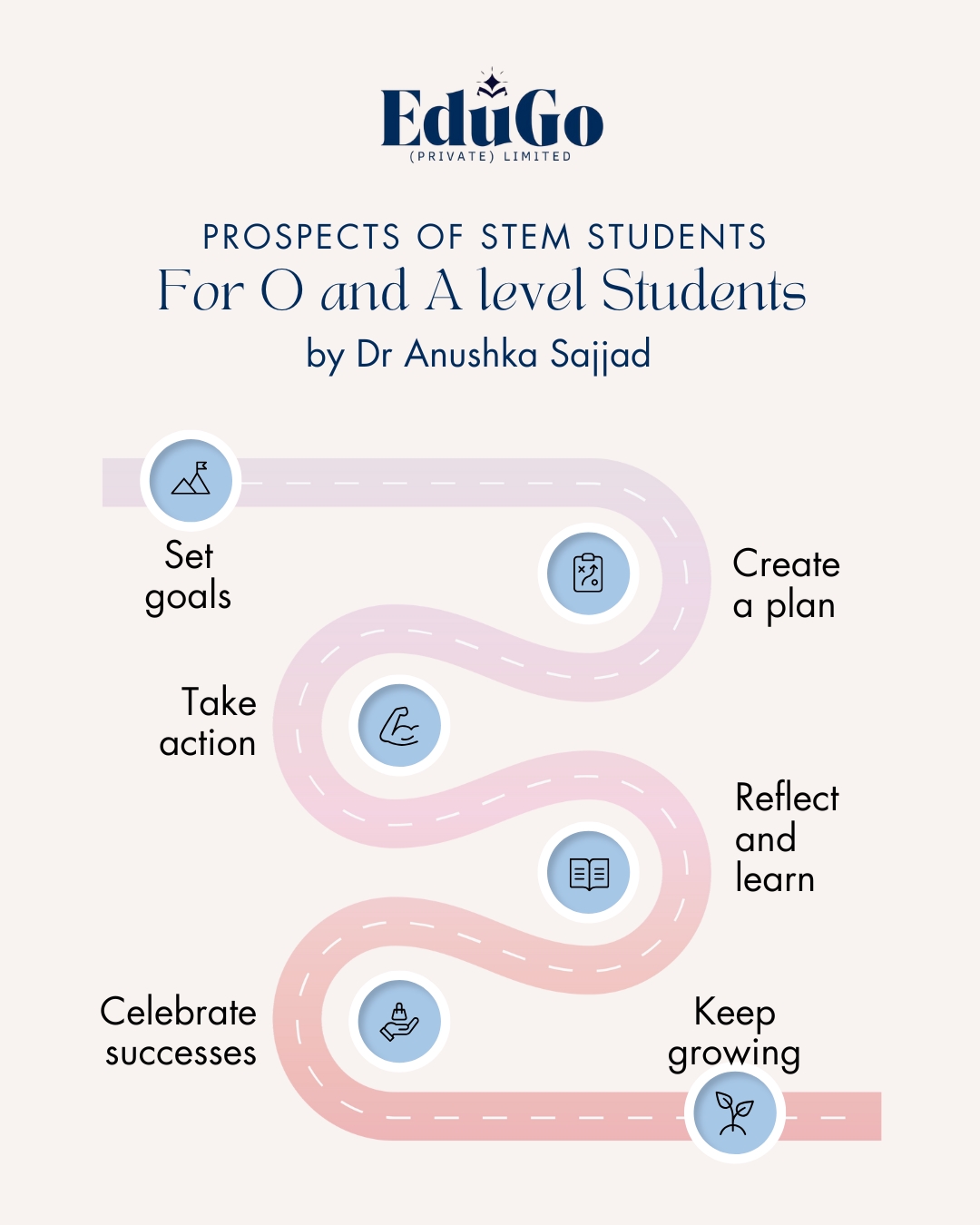
Prospects of STEM Subjects for O & A Level Students


Dr Anushka Sajjad, EduGo Consultancy

Subject selection for O and A Levels is an extremely exciting and challenging task for students of this generation because it not only determines the foundation for your future studies and careers but can also open doors to degrees, careers, and opportunities that didn’t exist a decade ago by including a minimum of one science subject in your subject list. In today’s world, science, technology, engineering, and math (STEM) fields are at the heart of almost every global industry — from finance to fashion, agriculture to artificial intelligence.

When I was selecting my O & A Level subjects back in 2012 and 2015, science subjects were for students who had one of two goals in mind: Medicine or Engineering.

Luckily, for the O and A Level students of this generation, STEM has branched into numerous fields, so studying a minimum of one science subject not only makes your application stand out but also improves critical thinking, data literacy, problem-solving skills, and provides a strong foundation for science-related careers.

According to the World Economic Forum (2024), 75% of the fastest-growing occupations require STEM skills, and by 2030, over 80% of jobs globally will demand some level of digital and STEM literacy. This shows that studying a STEM subject not only benefits you academically but also provides a strong financial return on your education.

The rise of interdisciplinary careers allows students to combine their STEM background with their passion. A popular example of interdisciplinary careers includes combining science and computer science, which allows students to become bioinformaticians, computational chemists, or health data analysts. These professions are highly valued in the fields of biotechnology, pharma, and even research. Combining science subjects with law focuses on intellectual property, environmental law, and biotech patents. Careers in this interdisciplinary branch include becoming a patent attorney (especially in biotech, chemistry, or engineering), an environmental lawyer, or a regulatory affairs specialist — all of which have high financial earning potentials. The integration of a science subject with arts focuses on science communication and medical illustration, and careers in this specific branch would include medical illustration and designing scientific software. Merging science with business/economics focuses on biotech entrepreneurship, product management, and sustainability consulting — allowing students to explore careers in biotech product management, science/tech consultancy, or even environmental economics. Blending science with medicine/healthcare focuses on health tech and public health, and possible careers in this include clinical research coordinator, genetic counselor, and medical technologist.

Being asked to select a subject or even a career at this point in your lives may seem extremely daunting. Some of you may know exactly which careers and paths you would like to pursue, and the majority of you may be on the fence about what decision to make. If you fall in the latter category, my advice to students would be to keep your options open and to select subjects that provide you flexibility, and the solution that provides you with that luxury is taking up a science subject. A common misconception and fear that exists around taking a science subject is that it’s seen as too challenging and difficult to tackle. STEM subjects may seem intimidating at first, but with the right support and mindset, anyone can succeed. What matters most is curiosity and the willingness to learn. With access to different websites, learning tools, and videos, with the right effort and dedication, students are destined to do well.

Conclusion: Why Every Student Should Consider STEM

The decision to study a science subject at O or A Level is no longer just for those who want to be doctors or engineers — it’s for anyone who wants to be part of the future. Even if you’re not sure what you want to become, including a science subject in your subject list keeps your options open, strengthens your university applications, and gives you real-world skills that are valuable in almost any career. Choosing science is no longer a limitation — it’s a launchpad.

Dr. Anushka Sajjad is CFO and Project Manager at EduGo Private Limited, which is partnership for Dawn’s Education Expo

The Future of Students: Why Holistic Education Matters More Than Ever


The world our students are preparing for looks nothing like the one we, their parents and teachers, grew up in. Artificial intelligence is rewriting industries, global mobility is reshaping opportunities, and skills that once guaranteed success are now barely enough to get noticed. In this shifting landscape, education can no longer be reduced to grades, test scores, or even university acceptances. The future belongs to students nurtured holistically; academically, emotionally, socially, and globally.

When I reflect on my own journey, I often think about the choices I made in my teenage years. I was a national-level swimmer, and the years I spent in the pool gave me discipline, resilience, and an understanding of competition. But in Grade 9, I chose to stop competing so I could focus entirely on my CIEs. I thought strong transcripts would be enough to carry me into a top university. I remained engaged socially and expressive, but by sidelining swimming I unknowingly narrowed my profile. Looking back, that was the worst mistake I ever made

What I didn’t know then was the concept of profile building. Universities abroad and increasingly, Pakistani universities too are not looking at transcripts in isolation. They are evaluating the whole student: leadership, extracurricular involvement, volunteer work, research, creativity, and personal resilience. By relying only on grades, I failed to showcase the swimmer, the leader, and the multidimensional individual I already was.

This became even clearer once I reached McGill University. Surrounded by peers from across the world, I realized how much earlier they had started building their profiles. Many had spent their high school years volunteering, interning, debating, or even launching small ventures. They didn’t just present transcripts; they presented lives filled with curiosity, initiative, and impact. When asked, “What did you do in high school?” their answers carried depth and direction. For too many Pakistani students, the answer still risks being, “I studied for my CAIEs and SAT.”

McGill taught me more than political science and economics. It gave me resilience, walking across campus in freezing Montreal winters. It gave me empathy, through friendships with people from every corner of the world. It gave me adaptability, defending my perspectives in diverse classrooms. In short, it gave me the holistic education I had missed earlier and it’s why I now advocate so strongly for it in Pakistan.

Top 10 Scholarships to Study Abroad for Pakistani Students

Why This Matters for Pakistani Students Today

With O & A Level results just out, many families are now considering next steps. But wherever you apply; whether the Ivy League or a Pakistani university, grades alone are not enough. In today’s competitive world, your profile is more than a ticket to admission. It’s the foundation of your future.

Pakistani passports, in particular, have to fight harder for global job placements. Immigration exists, but the process has become tougher and increasingly merit-based.

Employers and admissions officers alike are asking: “What did you do in your four years of high school?” The strongest answers show a balance of academics, leadership, service, and creativity; not just test preparation.

This is why profile building must begin early. It’s about starting your CV years in advance and being ahead of the curve. By the time you graduate, you shouldn’t just have grades. You should have stories, experiences, and skills that prove you can thrive in a global environment.

The Lesson I Carry Forward

I’ve made it my mission to give students what I myself lacked: structured guidance to build their profiles from as early as the end of Grade 9 summer. Because that’s when I chose academics alone, believing it was enough. I know the sting of realizing too late that you could have shown much more of yourself. And I know the power of encouraging students to pursue internships, research projects, volunteer work, or creative passions; while keeping academics strong.

Looking Ahead

The future of students is not about memorizing more facts. It is about becoming agile, empathetic, and globally aware citizens. As we step into a decade defined by uncertainty and possibility, holistic education will be the difference between those who adapt and those who struggle.

My call to parents, educators, and policymakers is simple: let us stop reducing education to grades and admissions alone. Instead, let us ask whether our students can solve problems, lead with kindness, and adapt to a world in flux.

Because the future of our students is not just about where they go to university, it is about who they become on the way.

Malaika Sakrani is Director EduGo, which is partner for Dawn Education Expo

Top 10 Scholarships to Study Abroad for Pakistani Students


Being an international student from Pakistan is certainly not the easiest task. With high costs and a complicated process, Pakistani students often feel alienated, confused, and simply underprepared. Do not worry we have you covered. There is certainly no mountain high enough to deter Pakistani youth so to help you with your search here is a list of the top 10 scholarship programs given to Pakistani students worldwide. 

These cover everything from tuition, visa, flights, insurance, and an additional living stipend. They exist at the masters level, and are offered to Pakistani students looking to study at any U.K. university! 

The Chevening scholarship is fully funded, it lets you study at any university in the U.K., and has no upper age limit. We suggest applying after you have garnered some work experience post undergrad and you’re good to go! 

Erasmus is a unique program where you study at a few universities across Europe (at least 3). It allows you to complete your masters at the top EU institutions. Scholarships for this program are available for Pakistani students and they cover everything down to a living stipend if you get them! 

This is probably the scholarship you have heard the most about. Available to all Pakistani Students who have completed at least 16 years of Education in Pakistan, the Fulbright masters and PhD program covers your tuition, textbooks, airfare, and living within the United States! 

Entirely funded by the Australian government, this scholarship allows you full tuition, a living stipend, return airfare, and overseas student healthcare coverage for your period of study! To apply, you must have a strong academic background, and be prepared for an interview with the Australian embassy. 

These scholarships cover full fees, living, and travel allowances! But the university you attend has to be one of the pre-approved institutions from their website, all of which are top-ranked and well-received for your masters. 

Funded wholly by the Japanese government, these are fully funded with additional stipends too! These are incredibly competitive, but worth every l effort that goes into the interviews, documents, and academic screenings. Unlike the other scholarships mentioned here, MEXT exists at the undergraduate and graduate level, but like some of the rest – you have to choose from a pre-approved institution list! 

Ranging from partial scholarship, to full with an additional coverage of travel and living costs – Cambridge Trust scholarships support promising Pakistani students as they pursue a masters or PhD at the University of Cambridge.

With a preference for individuals from countries like Pakistan, Stanford’s master and doctoral program scholarships include a competitive application process but  high payout in the end – all in the form of full funding, travel allowance, a monthly living stipend, and the chance to have a Stanford degree. 

KGSP covers full tuition fees, round-trip airfare, and living costs – all while giving you the chance to study and research at a South Korean university! These scholarships are particularly common amongst STEM students, so if you’re one of them, apply as soon as possible! 

Related Link:
Pak-UK education partnership programme

After Graduation in UK: Next Steps and Career Options


Did you finally wrap up your undergrad after three to four years of gruelling academics? Looking for further education or lost in the graduate job search? Confused about what to do after graduation in the UK? We list down the options for your next steps and career options.

  1. Masters: If you fancy a career in sciences, you may want to follow up your undergrad in the UK with graduate and postgraduate degrees. For instance, further studies in STEM fields would increase your employability. In the United Kingdom, most masters programmes are one-year long. Imperial College, King’s College, and Bristol University are good options for a career in STEM. For humanities students, UCL, LSE and University of Edinburgh are great fits – they’re all interdisciplinary and help you evolve beyond just academia.
  2. A gap year: If you’re still unsure, take a year off to travel after graduation to inspire some personal growth or find freelance opportunities as you go. Take up hobbies that can potentially turn into career options you can use to delve into the job market, and emerge as a stronger professional candidate. A gap year well spent is anything but a waste of time, and can go incredibly far in promoting your career.
  3. Training programmes: Opt for graduate schemes such as internships for recent graduates in the UK or fellowships that would ease you into the workforce, and simplify the graduate job search. Many companies in the UK offer training programmes that span over a year or two and include rotations within the organisation, enabling the graduates to immerse themselves in different fields. These schemes usually culminate in full-time employment.

Though the steps you take now can be formative for your career, remember that the market is vast – and whatever you choose to do after graduation in the UK, all that matters is that you’re able to derive satisfaction out of your career in the long – term. Good luck!

Related Link:
Pak-UK education partnership programme

Copyright © 2026 Dawn